Quarterback guide
Quarterback Progressions Explained
A progression is the order you look at the receivers on a pass play: first read, second, third, then the checkdown, each at a set point in the drop so the throw is on time. Some plays read half the field, others the full field. Some offenses teach a fixed order, others teach you to read one defender, and most modern passing games mix the two.
Updated October 2026
What a Progression Is
Every pass play has more receivers than you can watch at once, so a progression sets an order. When the first receiver is open at the moment the play says, the ball goes there. Otherwise your eyes move to the second, then the third, and finally the checkdown, the short safe throw that keeps the play from becoming a sack or a turnover.
The order is tied to the drop: first read at the top, second with a hitch step, third with another. Get to the right read a beat late and you still throw into coverage, because zone defenders close and man defenders recover.
Running a Progression
- Predict Before the Snap
Use your pre-snap read to guess which read is likely open. Some plays build in a pre-snap check, such as a yes/no on a single receiver or a free-access throw: take it when it is there. Otherwise you still go through the order.
- Safeties at the Snap, Then Your Read
See both safeties before the snap, then again right after it to confirm or deny what they showed. By the top of the drop your eyes are on the defender you read, not on a receiver. Staring at a receiver from the snap tells the defense where the ball is going.
- Decide, Do Not Wait
Open means throw. Covered means move on right away. Waiting for a covered receiver to come open is how QBs get late.
- Move the Feet with the Eyes
When your eyes go to the next read, reset your feet to that receiver. A throw with the feet aimed somewhere else is usually off target.
- Finish with the Checkdown
With every read covered, the checkdown is a good play. Throw it and live for the next snap.
Half-Field and Full-Field Reads
A half-field read works one side of the formation. The concept on that side beats the coverage on its own, and you ignore the other side unless the play has a backside answer built in. Quick-game concepts like Stick, Snag and Slant are usually half-field reads: fast, so they answer pressure, and simple, so young QBs learn them first.
A full-field read works across the formation, often starting on one side and finishing on the other or in the middle. Mesh and many deeper concepts are read this way. They take longer, and they give you an answer for nearly any coverage.
Many plays combine the two: a half-field concept to one side and a single route on the other that you look at first if the matchup is right.
Progression Reads and Coverage Reads
In a progression read, the order is fixed: one, two, three, checkdown, whatever the coverage. It is easy to teach and keeps the timing clean. The weakness: your first look may go to a receiver who was never going to be open against that coverage.
In a coverage read (or read progression), the coverage decides where your eyes start, for example the outside receiver against single high and the inside receiver against two high. Against the right look it is faster. Get the coverage wrong and your eyes start in the wrong place.
Most offenses mix them. A common version: the pre-snap shell picks the side, then a fixed order runs on that side. Crucible calls this a contour-specific progression: the contour (MFC, MFO or man) picks the side and the concept.
Read Keys
A read key is the one defender whose movement tells you where to throw. The concept leaves one receiver open whichever way that defender goes. Crucible teaches it as Read and Feel: your eyes on the read defender while you feel the next one.
The two classic shapes are the low-high (often called high-low) and the horizontal stretch. In a low-high, two receivers sit at different depths in one defender's area: the defender sinks, throw the low route; comes up, throw the high route behind. In a horizontal stretch they are spread side to side: the defender widens, throw inside; stays inside, throw wide.
A progression can use more than one read key. Each step has its own type of read (a Low-High, a Curl/Flat/Hook read, an Area read, a Triangle or a three-level read), so the defender you watch changes as you work through it.
Example: Stick
Stick is a half-field horizontal stretch on the flat defender. Widens with the flat route: throw the stick. Sits on the stick: throw the flat. Against Cover 3 the flat defender has two receivers to cover and cannot take both, which is why Stick is a staple against it.
Example: Snag
Against two high, Snag is a half-field low-high on the cornerback: a corner route breaking toward the sideline at 12 yards and a snag sitting underneath at about 5. A cornerback who sinks with the corner route leaves the snag open, and one who sits on the snag leaves the corner route open behind.
Example: Mesh
Mesh is a full-field concept built on two shallow crossers. Start with a quick flash to the back on the rail, then work the triangle: the cross over the top and the two shallows underneath. Against man, throw the crosser running away from the rat. Against zone, throw the shallow that settles in a window, or work up to the deeper route when the linebackers come up.
Example: Sail
Sail attacks one side at three levels: a deep pogo route, a sail breaking toward the sideline at 12 yards and an option route underneath. Read high to low: the deep route first, then the sail or the short route off the defender under the sail (the Curl/Flat defender against Cover 3, the curl linebacker against Cover 2 Tampa). Against Cover 3, the defenders on that side cannot cover all three levels. Against Cover 2 Tampa, the sail lands in the sideline hole behind the cloud corner.
The Concepts in This Guide
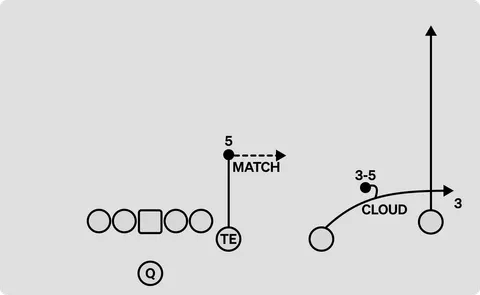
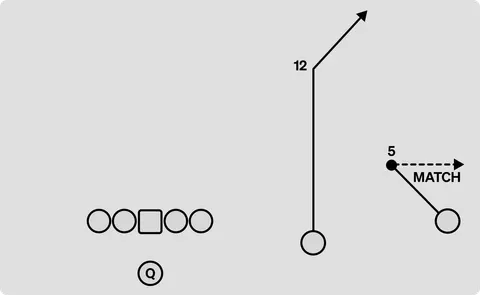
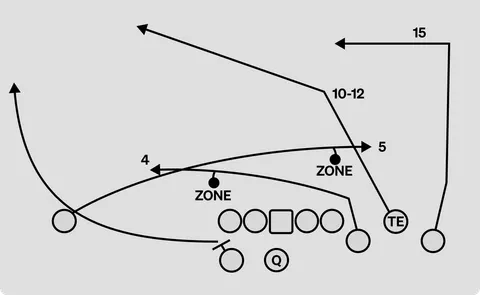
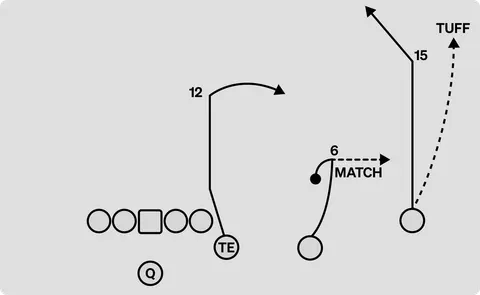
Know three things for every pass play: half-field or full-field, which defender you read, and where the checkdown is.
Common Progression Mistakes
- Staring down the first read from the snap. Defenders read your eyes.
- Skipping your progression on a hunch. Take a built-in pre-snap check (a yes/no on a single receiver) when it is a yes, and otherwise run the order.
- Moving the eyes without the feet. The ball goes where the hips and feet are pointing more often than where you are looking.
- Treating the checkdown as a failure. A completed checkdown beats a sack, an incompletion or a turnover.
How to Train Progressions
On air, run each concept against no defense and call your reads out loud at each step of the drop. Then add a coach or teammate as the read key and throw off that movement. In film, pause before the throw and say where the ball should go.
Simulator reps cover the part that is hardest to get in practice: many different coverages against the same concept. Crucible, an iPhone and Android app with no headset, lets you take the snap against a real coverage, read it, make the throw and then see what you missed.
Common Questions
What is a progression read in football?
The order a QB looks at the receivers on a pass play (first, second and third reads, then a checkdown), each tied to a point in the drop so the throw is on time.
What is the difference between a half-field and a full-field read?
A half-field read works one side of the formation and is fast and simple. A full-field read works across the formation, which takes longer but answers more coverages.
What is a read key?
The one defender the QB watches to decide the throw. The concept leaves one receiver open whatever that defender does: high if the defender comes up, low on a sink, inside on a widen, outside if the defender stays inside.
Should a young quarterback learn progressions or coverage reads first?
Start with calling the coverage family: MFC (one high), MFO (two high) or man. Then learn progressions where that call picks the side, with a set order on that side, so timing and coverage recognition grow together.